Monday, August 20, 2012

Back to School


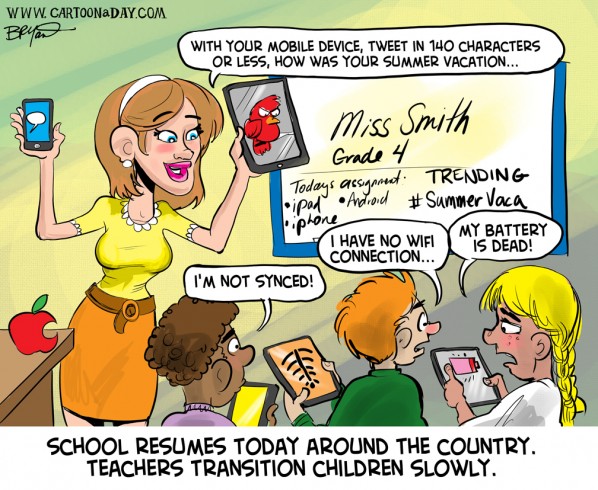
It's back to school time!

For parents, this can be kind of exciting - let's be honest.  For kids, this can be really a really nerve-wracking time. If you rewind back to when you were a kid you might have loved the whole back-to-school thing, but when a child struggles socially, school can be terrifying. You might wonder why your son or daughter seems to be biting their nails more, crying about seemingly small things and having trouble self-regulating - they might just be freaking out about school.

As a parent, here are some things you can do to help alleviate the stress:

(1) Make a calendar
You don't need to make anything fancy - just make it clear, and make it with your child. Grab a blank piece of paper and a sharpie and map out the days leading up to school's return. Mark in any events, appointments or activities that you know will be happening up until school's return. It might be a good idea to write in how many 'sleeps' until the big day. Post the calendar in a place where your child can see it, and cross off the days as they happen.

(2) Drive by the school 
A couple of days prior to school's return, it can be helpful to take a walk or drive past school - especially if it is your child's first day at that particular campus. Point out the place where you will be dropping off/picking up your child. If he/she is returning to the same school, talk about some good memories your child has from that school. Create some positive feelings toward school, where possible. Do it for a few days in a row if you can.

(3) Get a schedule from the teacher 
If possible, email your child's teacher for the weekly schedule of the class. Sit down with your child and show them how the week is going to look. You might just discover the subjects or activities that stress your child out the most. Some kids love free play/recess, for other kids, this is the most stressful part of their day. Kids with social differences often hold structure very close to their heart.

(4) Role Play 
Most kids learn to 'join in' when they are very young. They may ask what the other kids are doing, and whether or not they can play too. Some kids just don't pick up on those kinds of social cues and they need reminders. 'Joining in' changes with time - teach your kids age appropriate strategies for assertively including themselves via role play. If your child is older elementary or beginning middle school, help them out with exposing them to pop-culture that other kids will be talking about. Teach them ball skills to join in with sports. Help your child look their age by dressing them in fashionable clothing and cool hairstyles. If your child already has differences, help them blend in as much as possible on the fashion front.

Good luck! All the best from us to your kids!

Monday, August 13, 2012

Calm Down!


So, we have it on good authority that mercury is now out of retrograde. This means everyone should just calm the heck down, right? (OK. Good, thank you.) Now that the mercury issue is settled, let's talk about some other non-planetary methods of calming ourselves.

Life is stressful in general, even before you add children into the mix. Whether your kids are typically developing or not, as a grown-up human being it is important to develop a tool kit of responses to situations that raise the anxiety level up a few notches.

We thought we'd share with you a couple:

(1) Breathe!
This is the most cliche, obvious thing anyone could ever say to you. But have you ever truly paid attention to your breath before? I have noticed that my knee-jerk response to stress is a deep breath. Sometimes I am not even aware that I am feeling overwhelmed, then I do this deep, labored breath and it reminds me to slow down and take care of myself. Other times, I feel myself entering the crazy zone and I consciously stop and breathe deeply. A friend of mine once said that apparently if you breathe according to the beats of your heart you can never feel anxious. This is good advice except for the part where my inner musician wants to clarify how many bpm (beats per minute) the breath needs to be. I tried 4 heart beats in, 4 out and it seemed OK. We just met and this is crazy, but give it a try, maybe?

(2) Go Outside!
It is not particularly realistic for me to suggest that y'all go kayaking or scale a mountain when you feel stressed out. Did you know that the sun can make you feel happier? All that vitamin D goodness feeds the soul. Staying inside too much can start to choke your senses. If you can grab a few minutes of sun and fresh air every day, with or without kids in tow, you may just remember that things will get better eventually. Better still, get some exercise! Some families enjoy riding their bikes at the park, others enjoy shooting hoops or swimming. Find your family's niche and model an active lifestyle to your kids. They'll thank you for it later.

(3) "Listening Song"
I started using the "Listening Song" technique in the car as a non-punitive method of calming down when things got stressful in the car. One of my boy's stims was singing. He would sing constantly, and this would annoy his brother. They both have low frustration tolerance and sensory processing issues - next minute, all hell would break loose in the back seat of the car. Rather than have them screaming bloody murder while we cruise down the highway, I told them that we needed one WHOLE song where nobody was singing or talking - just listening. It was useful for everyone to get what they wanted, and for everyone to take a minute to be still. I also use the "Listening Song" after any car meltdown to give myself a moment before saying things to the kids out of anger, that I would later regret.

(4) Rescue Remedy!
These products (pictured above) are natural chill-out concoctions. Do they work? Yes. I was skeptical at first, then one day my friend and I put too much in our water... and we were giggling like middle school girls. I don't recommend the foolish misuse of the product (as mentioned by my foolish self) - always read the label! The product isn't chemical or addictive, and it doesn't make you sleepy like valerian. There are specific kids products by RR, so again, always read the label.

(5) Teach your kids self-regulation techniques!

BUBBLE BREATHS: Take a deep breath in, and raise your arms like a round bubble inflating. Exhale and slowly deflate the 'bubble'. This is perfect for those times you're in public and your child melts down and you need a way of stepping aside and calming him/her down.

DEEP PRESSURE: There are many ways to apply deep pressure to an anxious child, and you don't need to be an Occupational Therapist to perform them.

The first way is: A BEAR HUG! In the heat of the moment, you might not want to bear hug a kid with sensory sensitivities - they may hate it. But, as a preventative measure you need absolutely no reason to grab your child and hug him/her tight. This sensory input will remind your child where their body is in space, and subsequently calm them down.

When you see their engine revving up, grab your child's hand and sandwich it between yours - these are called HAND SQUEEZES. Most kids find this funny, and they like the input.

You can even grab some pillows/cushions and use your weight to (safely) squish your kid to the floor or couch for PILLOW SQUISHES. Sometimes I play this game with my SPD 6y.o. where he covers himself with a couch pillow and I "sit on the couch" and act like I don't know where he is. When he giggles, I take the pillow off of him and discover why the furniture is laughing. He thinks it is so funny, and it calms his system down so much.

{ALWAYS make sure your child can handle the amount of pressure you are giving them. If they can't breathe, or they say "OUCH" - then it is just about the worst game ever. Just be safe, people!}


Wednesday, August 1, 2012

Finding Babysitters

Do, a deer a female deer. Re, this babysitter does not exisssstttttt.....

If you are reading this blog, chances are, your child has some difficult behaviors. Let's be honest - all kids behave in a crazy fashion at times - but we're going to hazard a guess that yours may go the extra mile. A huge part of successful parenting comes from parents being able to take breaks away from their kids. Whether you can get away for an hour to do grocery shopping alone, have a date night with your spouse or maybe go away for the weekend (kid-free) - all parents need some time out from wearing their MOM or DAD hat.

The problem with being a parent of a special needs kid is that it can be difficult to find someone to look after them. We have seen some families go from babysitter to babysitter on a weekly basis, on a quest to find someone who can handle their children. We have seen kids act out simply because they know that their challenging behaviors cause a change in babysitter. If your child gets what they want by melting down, then their meltdowns have proven to be an effective method of communication (in their opinion) and they will continue to be, until something changes.

So, what are the big problems with the babysitter search?

The perfect babysitter doesn't exist
Sometimes parents have this idea that Mary Poppins or Maria Von Trapp truly exist and are waiting by their computers responding to advertisements on Craigslist. If you're in the market for someone to wave their magic wand over your kids and change them from wild animals to well-behaved upright citizens without you having to do so much as lift a finger... then... you are going to be waiting a while. You are the parent. It is your job to parent your kids - your babysitter's job is to keep them safely entertained while you take a break or go to work. There is no shame in needing help with the "wild-to-upright" transformation. There are services available, and we are certainly one of them. But the big disclaimer here is: It takes effort.

A cheap babysitter is not necessarily a good idea
If you buy a pair of shoes for $10 and they wear out in a month, you can hardly be upset. You got what you paid for. If you pay your babysitter peanuts, and she loses your kids or they start saying the 'F' word the next day - then you might want to (a) Never use her services again & (b) Value your kids enough to pay your babysitters well. I am not saying that you need to be rich to afford a babysitter - I am implying that if you don't pay your babysitter enough, s/he may not place much value on her time with your kids and therefore not do her best. In my younger years, I was a pro babysitter but I was shy about money. Once, I was left alone with 9 kids aged 18 months to 5 years while their collective parents went out for a wedding reception. One was a (relatively healthy 6 month old) premature infant, one was recently adopted, one was just learning to walk and a few were mischievous brothers.  I was 19 and I was paid $10 an hour. Do you think I would ever do that, ever again? Do you think those kids got A+ quality care? Not so much. If you are struggling financially, maybe try adding some perks to the babysitting gig - dinner, Netflix, WiFi and candy are all good reasons for a babysitter to return.

It is possible to over communicate
Some people with special needs kids feel the need to over-explain their children's quirks to the babysitter. This probably will freak the babysitter out. He or she will probably not sleep before arriving at your house - if they do at all. If you overcommunicate, the babysitter may request to be paid an exorbitant amount of money. We recommend that you explain enough to your babysitter so that they know what to expect, but don't give them a rundown of the child's entire emotional rollercoaster of the past week - especially the part where they ran away at the coffee shop, attacked the wall with a cheese grater, cussed at the supermarket cashier or gave bruises to their last babysitter.

It is possible to under communicate
More than likely, parents with special needs will undercommunicate to babysitters. If you do not warn your babysitter about the child's sensory sensitivities, s/he might decide that going to the movies is fun or that vacuuming while they watch TV is a harmless sport. If you don't warn your babysitter that your son hates cheese so much that if he even sees it he will freak out, she might decide to take them for a trip to the pizza parlor. If you don't warn your babysitter doesn't know that transitions are really difficult for your daughter, s/he might have no idea why suddenly turning the TV off and saying, "Bedtime!" is an unforgivable, meltdown-tastic mess. Armed with a few incentives and some tricks up her sleeve, your babysitter will be much more able to bare the tantrums and maybe even curb some of them.

Realistic expectations
If you have trouble getting your child down for a nap, probably don't insist that your babysitter be able to do it. By all means, it is worth a try, but the pressure of making it work may be too much for the babysitter and child. The worst babysitting moment I ever had was when a child's parent said that the nap was a necessity, then the child released his inner beast (hands, fists, fingernails and teeth were employed in the refusal of this nap) at the very mention of the N word (N-A-P). If your child only eats chicken nuggets and you leave the babysitter with a salad to feed the kid - you are being really mean to everyone involved. Where possible, make it easy for your babysitter to return. If your goal is to go out of the occasional date night, then it really doesn't matter if your child goes to bed without brushing his teeth. As long as it doesn't set a ridiculous precedent of substandard dental hygiene, you should do what you can to keep the babysitter happy and keep the kids happy with her.


Friday, July 20, 2012

You've Got a Friend in Me


The opening sequence of the Disney Pixar classic Toy Story shows Andy spending beautiful quality time with his BFF (Best Friend Forever) Woody. This is seriously cute when it's in a movie - but to run the risk of insulting one of the best movies in history - if your child's best friend is an inanimate object, you should probably have cause for concern. Humans were made to connect with one another!

If your child/ren have a hard time with appropriate social interactions, it will more than likely break your heart to see them isolated. Very few people can live a full life without the solid, consistent companionship of others. I have heard it said that some people with Asperger's Syndrome/High Functioning Autism want nothing more than to jump right into a life of social connection, but they have no idea how to match their desires with their actions. Often times, kids with HFA are so far ahead of their peers intellectually that they find "kid things" really boring ways of passing the time. There are hidden social rules that they are oblivious to - and suddenly all of their smarts count for nothing.

Personally, I feel as though it is worse to organize play dates with your children's peers if the other child doesn't want to be your kid's friend. I have seen typically developing kids protest about going to their ASD "friend's" house - in plain view of the socially-challenged child. Let's get real here: Your child might not be very good company to his/her peers, and this is something you may need to accept in order for things to get better. Looking at it through rose-colored glasses won't fix the problem. Your job as that child's parent/carer/support network is to feed them the skills that will ultimately help them to alter their behaviors to be more conducive to friendship. To be honest, my philosophy in life is that we don't have to be everyone's friend. I do expect people to be respectful, though. If one kid doesn't want a play date, another one will. Keep trying.

The biggest roadblock for some kids are their obscure fixations. If your child is stuck on one thing that is overly technical, adult or outdated - they will probably find it hard to have fun playing with peers. Every parent is different when it comes to TV, but I have seen some real advances in socially-challenged kids when they began to watch the shows that other kids were watching. Suddenly they have the keys to a world where they know who Perry the Platypus is - and for some children, that is the enough to get them invited to a birthday party. That genuine childhood connection is worth more than a parentally planned play date any day.

Does your child have ball skills? For most little boys (and some girls), knowing what to do with ball is a HUGE key to social acceptance. Sometimes kids with Autism Spectrum Disorders will have problems with their co-ordination/vestibular/proprioceptive senses and that creates issues with balance and body awareness. Basically, it is likely your ASD kid will have a hard time with knowing where his/her body is in space and because he/she is probably quite accustomed to being told they are very good at academic activities, will not be inclined to doing things they 'suck' at.

You can help them in two ways: 
(1) Encourage them to hang out with an adult who can teach them 1:1 a crash course in a few ball sports. Practice breeds confidence. Don't just throw them in a team sport without some kind of preparation - this will make things way worse. Believe me: you don't appreciate doing things you have no idea about, nor do they.
(2) Make your "failures" public with your child. Obviously within age-appropriate reason, share with your child when you have done something that hasn't worked and how you recovered from it. Be an open book - especially with epic social failures. Let your child know that they are not alone.

While doing everything you can to encourage appropriate human social skills, we have seen children with social challenges flourish with animal companions. Dogs in particular prove to be the most faithful of friends, with no expectation of verbal reciprocity. Kids with anxiety can relax in the company of a furry friend, and experience the unconditional love (and warmth) of unbridled doggie affection. Dogs aren't always perfectly behaved and their behaviors can be used as lessons to parallel the work you are doing teaching appropriate social skills.

At Kahlon Family Services, we offer groups in the San Francisco Bay Area to children of all ages who struggle with social skills. We also have staff members who take kids into the community for 1:1 direct work on social learning. We have found that explaining life to your child as it happens is the most effective way for them to know what is going on.

We have also found that Mr Rogers set a great example by telling kids that he likes them as they are. Try telling your kids that every day - no amount of encouragement is ever wasted upon a child.

Wednesday, July 11, 2012

Ian's Paradise


"The idea for Ian's Paradise came from a conversation with my 8 year old son, Ian.  I asked him what he thought of when he thought of being calm, completely at peace, trusting the world and all the people in it.  Without hesitating, he said, "Ian's Paradise.""
- Melissa, Mom of Ian (8) 


In this post, we chat to Melissa and her son Ian about their new business,  Ian's Paradise. Check out their website for more details!

Tell us a bit about how you decided to start your business.


Melissa: We had made lap pillows for Ian almost a year ago when Vanessa suggested it may help him. She had been impressed with the pillows that we made and suggested that we make them for other people. At the time it seemed outside reality and I didn't take it seriously. Then, a few months ago, Ian and I were talking about how to make extra money - I an wanted an electric train set and I wanted a new planter box. I asked Ian if he would like to make pillows to get the money we wanted. He brightened, said yes, and off we went!

How have sensory sensitivities impacted Ian's life, and your family life as a whole?

Ian: The sound sensitivity is wearing off - at the fireworks I even had my headphones off this time. In class, sometimes I do go and get headphones. Sometimes I bellow, "Silence!", but I am learning how to make a different choice. Sometimes, very rarely, I ask for a break. Sometimes I still use my (noise-canceling) headphones in class when my "people sensitivity" is up.
Melissa: When we are out & about, if things get crazy, as a family we find a quiet place to sit down and make good choices. Over the years, his sensitivities have gotten better because of a combination of Occupational Therapy, specialized yoga (YEAS) and Vital Sounds Therapeutic Listening program. We don't have to avoid large crowds anymore - but we now know more about what "revs" and calms his engine. Vanessa has shown us how deep pressure works, and when she first squished him with a pillow, he instantly calmed down and tension immediately broke. He likes the pressure, and now asks for us to "moosh" him whenever he needs it.

How do the pillows work?


Ian: They help calm me. I put them on my lap. They feel good and comfortable.
Melissa: One day we were being silly and put 4 pillows on Ian - on his legs, body and one on his face. I was struck by how much he liked it, and we put some photos up on the website of him covered in pillows.

Who are they for?


Ian: Customers.
Melissa: They will help anyone who has vestibular & proprioceptive sensory challenges. I am not a professional - but from experience - I have seen how much weighted items help people who don't even have sensitivities. If someone comes over and sees one of the pillows in our living room, they instinctively pick them up and put them on their body. I am not even sure that they are aware of what they are doing, or the sensation that they are creating - I simply see that most people really like having pressure applied to their bodies.

Explain your partnership with Kahlon Family Services & YEAS.


Ian: We make the pillows, Vanessa uses them.
Melissa: Vanessa knew that there was a demand for affordable sensory integration props. Now that we are in the flow of making them, we are selling them online. Vanessa also takes a few to her YEAS (Yoga Education for Autism Spectrum) training sessions and lets people have personal experience with how they work. The eye pillow is included in the YEAS program backpacks that are sold online and through Kahlon Family Services. If people want to order any of the other pillows, they are all available online at our website www.iansparadise.com


Monday, July 2, 2012

Being Proud of Difference


"A few years ago, I was on the bus in London with my 7 year old son who has Asperger's. He was standing up announcing each stop to the passengers, who were looking at him like he was from another planet. Up until this point, strangers had always found my son's quirks endearing. People would laugh with him, not at him. He would make people's day with his antics, and those who were sad would walk away happier from an encounter with him. But in this moment, nobody found it cute. I tried to put it down to cultural differences - maybe Americans just had a better sense of humor than the British? Maybe this was a tough crowd? But as time went on... it happened more and more. At 10 years old, people are now finding him weird. People look at him and see what appears to be a typically developing boy, and judge him accordingly. But my son has never been "typically developing"- his syndrome is invisible, yet his differences are not." 


This Mom's quote is a snapshot into the lives of many families whose children are different. Part of what we do at Kahlon Family Services is take kids into the community and help teach them the social skills required to live life in their local context. We'll admit - sometimes it can be uncomfortable to have Asperger's kids out and about because you never quite know what is going to happen next - sometimes it's hilarious, sometimes it's just plain awkward. The beauty of being part of their evolving social behavior is that we get to see rapid, measurable life skills emerge on a daily basis. 


We believe that social skilling should be done in a natural setting, and not in a condescending way. As parents and carers, it would be ridiculous for us to believe that we are always the teacher and kids are always the student. We can discover so much about life through the eyes of a child who doesn't fit in. The key is striking a balance between giving the child keys to appropriate social behaviors, while encouraging him/her to be themselves. Everyone is different; everyone should have a right to express their individuality. Our job is to steer that expression towards behavior that is conducive to forming consistent friendships, mutual/back-and-forth conversational skills and generally positive social interactions. 


Families who have one or more children with developmental delays don't need to be ashamed of their child's quirky public behavior. Use it to your advantage! You may not even know what your child doesn't know until they do something awkward: These are teachable moments! Once, we were out at Starbucks with a child and realized we were short one chair for our table. When we asked our 10 year old client to go and find a chair, we had no idea that he didn't know the social rules behind the task. Most people naturally ask the person sitting at the table if there is somebody sitting at at empty chair before we take it. But not this kid! He walked up to a man waiting for a date, and took the seat from opposite him. The man watched the situation unfold, and seeing as though the seat-stealer was a child, he got up and replaced the chair with one that nobody was occupying. 


Were we mad at the child for this inconsiderate social choice? Not at all. Put yourself in his shoes: A man is sitting across from an empty seat and staring at his cell phone. Imagine now, that you have no concept of the meaning of non-verbal behaviors. The seat is empty, why not take it? That day, he learned that checking in with people before taking the chair is a better way to go about acquiring extra cafe furniture. This is one of millions of life-skills that typically developing people take for granted. 


Your child may put a lot of effort into keeping things together socially during the day. It is common for Asperger's kids to have evening meltdowns about things that may seem insignificant to everyone else. It is likely that the kid who is screaming about not wanting to have a shower has just been pushed over the edge, and they are unleashing the inner pressure on their nearest and dearest. It may have very little to do with the shower, and a lot to do with trying to navigate social situations at school. Taking the time to teach your kids how to read social situations can greatly reduce these anxiety-related meltdowns and prepare him for more meaningful connections. On the flip side, giving down time at home to be engrossed in his fixations, sing loudly and be as quirky as he wants to be (within the safety of people who understand this is part of who he is) will help him realize that you love him for who he is. 


I have had many bus rides, coffee dates, playground adventures and beach days with kids whose behavior has seemed weird to everyone else. Sometimes these are the very moments these children are displaying huge social milestones, which are invisible to the eyes of onlookers. Be proud of who they are, ignore unproductive judgements and remember that you are this child's #1 fan. 

Wednesday, June 27, 2012

104 Days of Summer Vacation


"There's 104 days of summer vacation, and school comes along just to end it. And the annual problem of our generation, is finding a good way to spend it...." 


It's that time of year again: Summer vacation. If your kids love Phineas & Ferb as much as our kids do, I am sure they get quite a few ideas from these cartoon brothers about activities to do on their break from school. But, as parents, we know that summer can pose some logistical inconveniences. If your child is one who loves a schedule, then summer can be... dare we say it? Stressful! 


For  kids on the Autism Spectrum, the daily grind is comfort. But our job is to help flexibility be fun, and coach our kids into being OK with changes. Maybe your kids are in summer camp, or summer session in school - this alleviates much of the problem with scheduling. For some kids, even these slight changes in routine can cause major meltdowns until routine sets in. Sometimes, just as routine sets in the camp ends and you are back to square one. If you are traveling with special needs kids - you may be dreading the thought of airport waits, plane delays, long flights and sibling rivalry that comes with weeks upon weeks of your kids being together. For some kids - especially in San Francisco - the warm weather can make them act like one of the 7 Dwarfs. Which one? GRUMPY. 

So, we have some ideas for you on how to make summer a time of rejuvenation, spontaneity and family fun! 


(1) Schedules! Schedules! Schedules!
You may feel like scheduling summer is a lame idea. You may feel that it is even counter-productive in teaching your child flexibility. We have come up with a compromise: schedule time for spontaneity! If your child is on the spectrum, or has struggled with anxiety, you may be familiar with laminated visual schedules that have icons stuck on with velcro. If you don't already have one, you don't need to make one because they are very labor intensive. Depending on the age and development of your child, simply taking a piece of paper and writing down/drawing what is happening in their day and posting it up somewhere in the house can help. It will also help if you can make a calendar for all the weeks until school goes back. You don't have to fill it all in to the day, but if you know you are going away or have a special event coming up, let your child see it. If you want some time to throw caution to the wind, then make an icon/draw a "?" Question Mark - explain to your child that means that you don't know what will be happening then, and that is OK, because life isn't always totally planned out. 

(2) Beware of siblings spending to much time together
Sometimes we can expect siblings to play together for long periods of time, when it is likely that they may be arguing a lot because they are quite frankly... sick of each other. In school time, the kids probably don't see each other this much. If your child is on the spectrum, it is likely that they need some coaching to make appropriate social choices and this puts extra strain on sibling relationships. One way to combat this, is to make a time every day where the kids spend time apart. Maybe one child can have special time with a parent, maybe one child can help make dinner, maybe you could plan regular play dates... there are endless creative ideas to help your kids have time out from one another. 

(3) Spend some quality time with your kids
Kids need quality and quantity time from their parents. While it's summer, you have more opportunity to connect with your kids without necessarily having to stick to rigid bedtimes or school routines. Take some time out to get to know each of your kids for who they are - there is no substitute for parental attention. You will be surprised how much positive attention will impact even the most difficult of children. Being fully present with your child will change their world for the better. 

(4) Be creative with activities
Let's dispel the rumors: You do not need fancy vacations for your kids to have a good summer. We have seen kids have more fun drawing in sand with a stick, than traveling across the Atlantic. Life is what you make of it. Finding something fun to do that is free can be a skill that not everybody possesses - but that doesn't mean you can't learn. The internet has endless ideas of things to do in your city, your neighborhood and even your home. When was the last time you threw a sheet over the dining table and made a fort? When was the last time you had a picnic lunch at the local park? When was the last time you made fruit smoothies and froze them into popsicle molds? You don't need to pay a bank for activities, you just need to provide something out of the ordinary. Keeping your kids entertained is one thing - but teaching them to entertain themselves is something entirely different.